Search This Blog

Showing posts with label blended learning. Show all posts

Wednesday, November 3, 2021

Building Communities Online

I recently presented at Canopy Live on building communities online. This is a session I trimmed down from a full day's training that Dr Lou Mycroft and myself offer colleges and schools ( happily discuss more about this with anyone interested, anytime).

“Students said they were more likely to engage when they felt that staff valued them, were reliable and consistent in their engagement with online work, and had set up effective support measures.” 

(Palmer et al., 2017)

I purposefully include this from 2017 as I think anything pre pandemic is interesting. Not that what we learnt in the pandemic isn't interesting, but I like to highlight that online teaching happened pre pandemic and we learnt a LOT from that time too.

I don't think this quote is telling us anything unusual. Students want to feel valued. We all do. That is the practice of care (if you ever spend time with Dr Mycroft you will hear her speak to this often) that is education. How do we show students we care? What conditions for them to excel do we create? When teaching online how do we check in?

Also at Canopy Live was the wonderful Cat Lamin. She shared about how important it is to check in on others and your own mental health. She used this duck scale to ask us how we were.
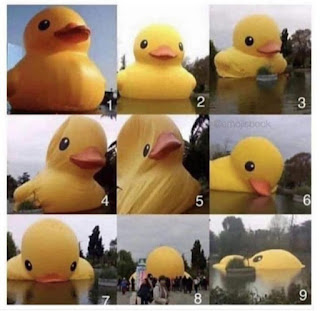
pictures of stages of deflating inflatable ducks
What I like about the duck scale is that it is open to all, everyone can relate to the stages. This is one type of check in, there are others. What is important though is that we check in. I tweet regularly that the algorithms on social media show you what it thinks you want to see. To build community you have to go beyond the algorithm. Seek out people to connect with, topics that interest you. Scrolling isn't the way to build community on social media. Active dialogue is. Engaging with others, seeking voices different to yours to learn from. We rely a lot on platforms to deliver what we need. Think about a VLE. It shows you what you want to see, who has done the work and when. What it doesn't show you (instantly, agree that this is possible with back channels and extra interventions) is how the work went for students? How did they feel? Was it appropriately challenging? That's the human conversational part that we need to add in as an extra to our work. Likewise on Twitter, it delivers the information it is required to deliver. Scrolling until your hearts content, but the human interaction and connection is the work that you have to do.
Have you checked in recently?  The algorithm decides what you see

If you are serious about building communities online, you might want to consider checking in, with a duck or without. The feeling of value you will show another in doing so cannot be underestimated.

Once you have checked in, how do you let students know that you value them throughout the lesson? I am reminded of a colleague who was once upset that a student failed to acknowledge her lovingly crafted feedback on each page of a students work. The student wanted to know the grade and what to do to improve in summary and disregarded hours of teacher feedback. Had the teacher asked what feedback the student had wanted there would have been a different outcome. Think yellow box marking where one section of yellow boxed work is marked intently. I have seen this include students self selecting the section to be marked also. The student has owned their work and indicated that they only require this section to be marked. The teacher marks that section with the level of feedback the student has asked for. Recognising whole college and school policies often dictate how we mark, but I think there are elements in this that can work and I have seen work well.

Teaching online, we can replicate this by indicating the yellow box. But that verbal feedback as we would traditionally circulate the room are slightly trickier. Sure we can verbally offer feedback, perhaps not whole class and maybe in breakout rooms? My go to technique is to use comments in student work live. I take a helicopter view of one slide deck. Each slide has the task, space for student work and each student's name on top. I then share one doc with the class with edit rights. Version history helps reinforce my expectations of etiquette and respect for others work in the doc. Each student navigates to their slide in the deck and works. I can see the colour code for each student as they work. I can then add comments live.

screen shot of adding comments in Google Slides

I can toggle my view to grid view (slide sorter view in PowerPoint) and see everyone working at once. I can see work appear live and dive in to slides where I think students might need help. Students feel safe to contribute, we have established expectations and I have reminded them of version history. Students feel valued that I can give them feedback quietly and as I would if I were circulating the room. Students could see each others work in the room normally, online they can too. If this were an issue for my students I would maybe move this quick, instant verbal feedback I am replicating online to Google Chat or private comments to students. I am showing students that I value their work and I am supporting them in their learning. We are all connected and building a learning community online.

Referring back to the initial quote, the value students perceive is also in expectations and support. Backchannel chats are a supportive measure my students enjoy. Our backchannel is via Google Chat. Students can privately message me live with how they are feeling, issues, ideas and I can support. Something like Backchannel Chat is also appropriate. That immediate support of knowing that your teacher is there and will be able to help is an effective support in itself, just the knowing. My students mainly share emojis at the level of challenge they are experiencing and my job is to support them to overcome that fear or work through it to achieve their potential in that class. This is time consuming and mentally taxing for me as a teacher, but since when was teaching not either of those things? We do what we need to do to help our students. I find setting a self marking activity for the class useful whilst I manage the back channel at key points in the lesson invaluable. Otherwise students would be left looking at my thinking face whilst I manage all the communication modes.

emoji face thinking


Friday, May 7, 2021

Conscious Conversations

 How many people have you spoken to today?


Did you see someone whilst walking the dog? Did you bump into parents at the school drop off? Have you rang your mum? Did you chat to someone on the train through your mask?


When we were face to face in a pre-covid world. I don't think I counted these conversations. I live in Yorkshire so it isn't uncommon to strike up a chat with a stranger on public transport or in a coffee shop queue. I would love to know if this was uncommon where you live too?


When in college in the pre mask wearing days you would often find me chatting in corridors, bumping into colleagues as I went about my day. If I am honest those conversations probably made my day. Our college had campuses across the city centre and one of the highlights of the week would be wondering who you would bump into either to or from one of these cross campus jaunts. The journey often felt much shorter if you walked and talked. It was also especially joyful if you hugged a colleague as you dashed across the city square racing in opposite directions.


Yet at the end of the day when I came home to debrief to my partner I don't think I counted these encounters. But now I am mainly online I do. I daily update my partner on the 20 minute chat with a colleague, the hour meeting with a new team and the multiple whats app chats I have had with my friends. I am conscious of these conversations.


Conscious conversations has become my new thing on my to do list every day. To make sure that I have these interactions for my own wellbeing. I have discussed this concept with colleagues who have all made agreeable sounds and nods. Is this a concept for us all in this covid world?


Are we meaningful in our interactions? 


I would direct you to this great piece on consciousness and intentionality here


Are the two dependent? Do we need to be intentional to be conscious? Especially in our conscious conversations?


We learn more when we have other voices in our lives. A wider network informs us of wider perspectives and helps shapes our views, positives and negatives. How do we bring reality to some of these online conversations? Perhaps we don't need to? Many, if not all, of my new friends and colleagues I have never met face to face. Of those I have it has been briefly. Yet the bonds and connections that have been formed between us over the past year and more has had a significant impact on my life. Not just my well being but my professional life and my personal thinking. Because I can engage more globally I have. Broadening my spheres. This is all with intentionaity as I have found my why. See my blog about finding your why here.


Welcoming other voices and actively engaging in spaces are two different things. You can say you are open to all but inviting people to share with you is different. Take the practice some people adopt that when you follow them they RT your name or they send you a DM to thank you for following them. That is actively engaging with new voices. Following back is showing that you are open. There is a difference between being open to others and actively inviting others to share with you. This is intentionality. These are conscious conversations.


There is a difference between intentionality and conscious conversations. I am intentional if I follow back. I am opening a conscious conversation if I DM or tweet your name. SJ @WhatTheTrigMath


Conscious conversations are the process I take now making sure I am intentional with my time. It brings joy to chat to so many wonderful people all around the world, hope we can connect soon!

Sunday, January 24, 2021

FlipgridForFE

 We have been running a series of tweets recently under the hashtag #FlipgridForFE. We have had many requests recently either via our one to one sessions or group sessions of "what's the best way to do..." "how can I get students to do..." and most of the time our answer is Flipgrid.


Teachers are working at an enormous rate to make lessons as great as they can make them. You wouldn't be hanging around working all these hours in these ever changing conditions were it not for the love of the job at the minute! Teachers want to replicate their face to face classroom online, but this may not be possible nor the best idea depending on the group. Thinking about Puentedura's SAMR model we can place our activities against this framework and see are we substituting or is it better to augment the planned task online? 

Thinking about the key 21st Century 4C Digital Skills; communication, collaboration, creativity and critical thinking our SHED resources serve as a great tool for developing those skills. Sketching the problem creatively, critically highlighting key information, estimate a sensible answer using critical thinking. Followed by collaboratively communicating in a discussion to establish whose sensible estimates were correct. Flipgrid serves as a great tool for collaborative communication. Although students record videos individually whilst in lockdown they can collaborate by using comments, helping respond and reply to others ideas.


Flipgrid has a great mirror flip feature. This means that if you have a homemade visualiser (all my iterations here) you can record a model answer on Flipgrid. You can create a topic where you ask key questions, upload a video of your model answer and invite students to share theirs. Hattie  talks about modelling by a competent teacher having a positive impact on student learning. In this period of online teaching we can often feel far away when trying to scaffold and support, modelling is a great tool to support these aims. Flipgrid allows you to model with the old pen and paper where needed with the mirror flip too. The physical distance of student and teacher can be narrowed via Flipgrid when students talk as they write or show their work. Explaining why they did what they did may help you assess their level of skill greater than reading their written work as well as building connections between you both.

Flipgrid is great for giving feedback for students too. Anecdotally on social media we are seeing teachers herald the speed of their assessment and feedback with the use of video or audio tools. Recording a 30 second video of feedback is probably quicker than typing against a mark scheme, and more enjoyable! Video feedback builds social connection with learners, closing that physical distance bringing teachers closer to students. Students feel connected and the personalised nature of feedback
When setting topics on Flipgrid you can add in a custom rubric. This means that you can mark student video submission with a few clicks against your assessment criteria. They can also see the rubric as they submit the video. They old argument, how do students know what good looks like if they don't have a reference point! Both through model answers and the criteria they are being assessed against. Hattie says "The most powerful single influence enhancing achievement is feedback" Once students have flipped on the Flipgrid you can privately mark their work either through comments or a video response. Making feedback personal via video  may help those messages form in the student longer term memory too. 

We have blogged about using Flipgrid for staff reflection here but thinking about the new lockdown the issues still arise of staff isolation and staff lack of community. Staff may be missing that drop in to the staffroom to share how their lesson went, that offloading of class 1 on Monday morning who always put them through the wringer! Flipgrid could be a vehicle to support staff with this. Leaders could create a Flipgrid for staff communication could be powerful to help staff feel supported. A short video sharing how their foray into using a new tool could inspire another staff member who views it to give it a go. A positive comment underneath from a colleague saying I hear you and I am here for you may go a long way.

These are a few of our VERY long list of ways we encourage staff to use Flipgrid and the evidence that informs our thinking. If we can help you or your school or college with Flipgrid or any part of education technology please get in touch.


Thursday, October 29, 2020

The Uphill Struggle

 The marking stacks up, the need to make sure your tracking and data input is up to date, internal verification sampling, chasing non attenders, pastoral admin, this is just a snippet of the roles teachers play before they even get to think about planning and delivery of learning to students. Teacher workload is spoken about all the time but little seems to be done about this challenge. There have been initiatives and reports but has the finding of these made their way to the frontline? The huge increase in 2020 for digital online teaching has left teachers on their knees in many cases. But, could this move be the answer to reducing teacher workload and making the profession more sustainable?  


I would describe teaching in the further education sector as constantly being in the path of a tornado. Tornadoes generally have wind speeds up to 110 mph. You can see them due to the condensation funnel they travel for a few miles and then disappear. This metaphor I believe is a good way to describe the ever changing landscape of FE, the new initiatives with some sticking and some disappearing after a few miles. This constant change, pressure and lack of time to adapt causes many teachers to take a long hard look at their jobs and go “is this really for me?”

Tornado alley is a term penned to parts of North America such as Texas, Oklahoma and Louisiana where tornadoes occur most frequent. Teaching in FE is somewhat like living in one of these states, you know the weather can be unpredictable and at certain times of the year your home could incur damage or be destroyed thanks to mother nature. Although an extreme example, the pressure that FE teachers face at different times of the year is quite immense. This year the use of technology and blended learning has provided the latest tornado, but this one isn't going away and actually we need to learn to live with it.


Perhaps the biggest challenge we all face, not just teachers is a lack of perceived time. This has been dramatically increased this year due to the requirement to plan, teach and deliver online learning. But as a result how much innovation do you think has occurred? Teachers trying things they might never have tried before and potentially failing and trying something new again. Amazing. Technology really can be our extra pair of hands if we know what's out there and how we can leverage it to our advantage. Moving away from the fear and resistance to make it work properly and developing our knowledge working with it in partnership. The road isn't smooth and there will be lots of challenges. 


Failure is simply the opportunity to begin again, this time more intelligently.”

Henry Ford


The celebration of the volume of innovation in my own opinion has been overlooked throughout 2020. There has been so much great adaptation and practice to the way we deliver learning it's like ten years rolled into one. So could this new found innovation and practices support teachers on managing their workload in the long term? I believe the answer has to be yes….. And I will tell you why.


When you learn to drive, let's be honest it's tough. Most of us would have been passengers in a car but there is nothing quite like getting behind the wheel for the first time. 10mph feels like you are driving a racing car; it's such a weird feeling. After years of driving it becomes second nature you don't have to think about what you are doing, your subconscious basically does the job. Have you had one of those journeys where you arrive at your destination and you remember nothing of the journey? At present many teachers find themselves at the learning to drive stage. We have gone through various amounts of lessons, we might have also completed our hazard perception and now we are looking forward to the test. Everything is a process, getting our heads around new ways of working, learning and living will of course take time, provide us many barriers and challenges but as a result help us grow. As with every new skill the key to mastery is consistent practice and self discipline. It is key we maintain the progress made as I believe the use of technology will have the greatest impact on making teacher workload sustainable.


If you have read any of John Maxwell's books on leadership you may have come across his uphill and downhill metaphor. Uphill is very hard, it's challenging and everyday we have to take a few steps in that direction, tackling head on the challenges before us. Downhill is easy, we can slide away with very little effort required. But if we slide down hill we lose all of our uphill progress. Now, for many, times are hard, it's a challenge we may even hate it, but it is forcing us to grow and develop. We must continue the uphill struggle, because when we get to the top the view is magnificent.  


The next 12-18 months will be key to our uphill struggle. Teachers who are confident with digital tools are going to need to work with colleagues to support them and their upskill up the hill. The driving instructors to the learners. Together is better, learning is messy but many hands will make light work on the clear up. If the digital capabilities of teachers improves, it is my belief so will the ability to develop working practices and save time in administration and workload that occurs outside of the classroom. There is so much information and resources out there that there is almost too much. My advice to teachers would be to look at what you know and what you think would benefit you in your journey up the hill. Talk it over with a colleague, ask for help, open the door on your practice and reap the rewards. 


The tornados will keep appearing in FE, who knows what the next ones might be, but over time we can predict, monitor and overcome these challenges. Working together is key and making sure we do not start sliding down the hill. Let's keep talking, working with one another, sharing our uphill struggles and keep moving towards the summit.


Thanks for reading.  


Friday, October 23, 2020

The pedagogy

When we began teaching online in lockdown, it was an emergency. We were crisis response teaching. We were forced to deliver lessons, quickly online. There was a raft of pdfs printed and sent home as well as links to good websites shared and teachers began synchronously delivering content. There was a focus on getting content out there, quickly, and rightly so. Students needed some normality to continue. Those safe adults that had taught them in their physical school were still showing up for them and were still there for them teaching online. 

We have moved on now. Now we have collapsed bubbles. Socially distance classrooms. Hybrid classrooms with half in half out. We have blended learning, flipped learning all going on. This time though it is intentional. This is the new education. This isn't a crisis response this is our approach to planning in these new long term circumstances. We can all see that classrooms of 30 may not return for some time unless massive physical redevelopment of institutions happen because space is tight. The challenge now is to reflect on our pedagogical approaches and seek ways to develop and include those in our classroom be it physical, online or hybrid. 

Taking this article from TES 
What is pedagogy?
By Tes Editorial on 10 December 2018 accessed 24th October 2020 I wanted to explore how this may look now in our new way of teaching. I have purposefully chosen an article that isn't recent. This is two years old since writing and the concepts discussed are much older. I chose this because I think a lot of the same rules apply when teaching online. 

Behaviourism

Lecturing is easily replicated online. We can screenshare our presentation. We can orate our lectures. Learners can listen. Modelling is also easily replicated. We can use a blank slide in our slide presentation to model answers, we can insert images and annotate too. For those craving a whiteboard and pen we can easily do this too with IPEVO software or Flipgrid and mirror the screen when writing on a mini whiteboard at home. (one of the best tutorials on this is here by Daren White) By using a mirror you can film using you laptop or chromebook camera the keyboard of your device. Then pop a mini whiteboard, or laminated card or paper to cover over the keyboard and model away. The IPEVO or Flipgrid software will flip your mirrored writing to appear the correct way round for the learners watching online. 

Constructivism 

When teaching online we can slow the pace down for our learners. We can scaffold with a separate resource. We can share in the chat box of our online video call, additional text or ask learners how they are managing. If we wanted to anonymise student responses we may want to use a poll system like Slido, Peardeck, Mentimeter, Wooclap or the inbuilt tools in the video conferencing software we are using. We can take pulse checks of our teaching and reflect and adapt where we go next based on student feedback. 

Social Constructivism 


Group work can be replicated via tasks set and assigned to groups of students in our LMS. We can assign to different students different work via Google Classroom or Microsoft Teams or whatever LMS we have. We can create slide decks of presentations with tasks outlined asking for group or pair collaboration on the same deck. We can use version history or track changes to see who contributed to the discussion. We therefore have a record of that group discussion that previously in a physical classroom we wouldn't have had. We now know if there are passengers in the group or pair work task and can support. We know now if there are dominant team players and we can support them too. This group or pair work doesn't have to happen synchronously. We can set a slide deck and ask learners to contribute when they are doing their task, this works for asynchronous and synchronous learning. In Google slides a simple FILE>Version History we can see the changes in the slide deck over time and assess learners group or pair work and participation with more of an insight than we may have had in a physical classroom. 

Using our video conferencing software we can either use breakout rooms for group or pair work or we can create meetings just for the groups or pairs to attend. We could schedule 3 meetings at the same time, and assign the code to the meeting to each of the groups or pairs if we wanted then to work synchronously. We as the meeting owner can visit each of these rooms to check progress. We can schedule small groups across the week where we as teachers deliver small group instruction via video call. 

Liberatonianism


Student choice can be created via hyperdocs. We can create an choice of topics or activities for learners, links to exciting resources all curated into one hyperdoc. We can use visual stimulus to inspire learners in our hyperdocs and insert images. It's then INSERT>Link to link to the online resource we have chosen. 

Students can show what they know by presenting on a video call with you or their peers. This can easily be recorded either via the software of the video call or a screen recorder like Hippo Video, IPEVO, Screencastify, Loom, Screencastomatic or many others. Students could record a video themselves using these tools and post it back to teachers. Students could create infographics to show what they know in Canva, Venngage or even Google Drawings. Students could curate their own resources to answer or support their answer to a question and display these in a Wakelet, Lino, Padlet or their own hyperdoc slide deck. 

Students can show what they have learnt or answer questions via Flipgrid. They can orate their thought process. They may have more time to do this. They may feel less pressure than in a physical classroom when doing this. You may gain more of an insight into your learners via their content in using this media. They could show their answers via dance, via song, their creativity can really shine through.

I've included this part as a reminder of when I was taught to be a teacher. I was taught via lecture face to face. I was taught the pedagogy. I was then told to go into the classroom and develop my own approach. Over the years my approach has evolved from those early days in the classroom. Group work has increased in my focus, teacher talk has reduced. This is through my reflections on my teaching. My growth and development as a teacher. That doesn't change now that I teach online. I am reflecting on my pedagogical approach in the physical classroom. As I reflect, I see that many strategies I physically did in the classroom can be replicated online. Yet I am excited and enthused at the new opportunities of teaching online and the new pedagocial approaches I can develop. I hope this blog has helped you feel the same. SJ


Monday, October 12, 2020

SHED

We have been on a long (ish) journey of planning for next year. We have been thinking about how to move things online. I love Puentedura's SAMR model as a starting point. I like where we are, the posts I am seeing on Twitter, I like the buzz. Things are looking good. But there are still some things that we cannot replicate. That thing where only a pen and paper will do...oh yes writing answers to maths questions. Well writing answers to any questions. Until exams move away from being a paper based exercise we need to practise the skills required regularly. And actually if I am honest when I am planning I like a pen and paper first, sure a Jamboard, a Padlet, a Wakelet all help but initially I like a scrap of paper and a pen. Recently I have been doing some design thinking as part of my Google Innovator programme. This got me thinking about the importance of sketching out initial ideas. Design thinking is a process and whilst it isn't appropriate to adapt it as a one size fits all, there are some elements that I would love to pop into my teaching in this new normal. 

The power of creating a visual representation of your idea is huge and the introduction piece explains the science behind it. Ultimately your brain likes it better when you draw out your ideas as a picture. My brain likes lots of things as a picture, I am not a 'visual' learner (we can debate the relevance and significance of these theories another time!) I don't sketchnote. I am terrible at drawing. This isn't the point. The point is my brain accesses an image quicker, retains it easier. Your brain may be different but I look at my kids and I see they like a picture too. 

I am forever at a loss as to how to best support learners with answering those open ended problem solving question in maths. For those of you who are not maths people I apologise for any traumatic flashbacks you may now be having about two trains leaving and travelling at different speeds and having to calculate which will arrive first. But these questions are in a lot of subjects. In Science the 6 mark questions that require a structured planned answer to access all the marks. In English the paper 1 question 4 that needs a planned structured response. In functional skills maths the planning a day timetable questions. These are just the subjects that came to mind as I was writing this. I am sure there are more. The scenario I am talking about here is the question that requires a well thought out structured answer and there is no obvious start point for students to grab on to.

In maths these are called problem solving questions. They are scattered all over the place, low grades ones, high grades ones, calculator and non-calculator. Students very often plough straight in and muddle their way through. In my experience often on the wrong track and if they had taken a moment to pause they could have done better. If you recognise this in your teaching and your subject, phew I am glad I am not the only one! Years ago I was on a learning differences course from the Friday Institute MOOC and came across SLED, which I have blogged about here on WhatTheTrig.  Looking at the new normal and how we are going to approach this digitally I began playing about and came up with SHED.

Sketch

Highlight

Estimate

Discuss

Imagine you don't know where to start with an answer to a question, can you sketch out a quick picture of what the question is asking? Can you sketch a quick plan of what is needed? Can you draw the people involved to connect with them?

Can you highlight the key information in the text? Can you extract key points?

Can you estimate an answer? Roughly speaking what is the answer they are looking for? What would be a good guess? 

Can you discuss with your peer and see what they thought and maybe through collaboration finalise your answer?

This draws on a few pedagogical bits for me. The power of collaboration is HUGE. I like this as a piece on collaboration. More importantly than listening to me, all we need do is look across the pond to teachers in the USA who have been preparing students with 21st century digital skills for some time and collaboration is one of the C's. The 4Cs are huge. We have 6 where we work, some places have 5, but the core 4 never change. At Driving Digital we are huge fans of these skills. We have a new course coming on them soon, an intro here

The 4Cs are not going away, they have been around for ages and they will be relevant for some time to come. I have blogged the need for teachers to model them before delivering them here before. Let's take a moment though, who wouldn't want a learner who could communicate well, be creative, collaborate with others and critically think through problems. Believe them to be gimicky or not but they are skills that I am happy to help my learners develop. 

So SHED then, sketch = creativity, highlight = critically think and reflect, estimate = communicate, discuss = collaborate. I think it is a nice easy way to embed these skills to be delivered in my GCSE maths classroom. Take this question: 


Typical GCSE problem solving question. I can sketch some money bags and some coins, I can highlight the different and same and twice. I can roughly guess an answer and then I can talk to my partner. Except I am remote learning and I am sat at my kitchen table on my own. So I played a bit more and moved the SHED (enjoying the imagery too much, apologies!) into Google Slides. For clarity I am a Google Innovator and Certified Trainer so Google is what I know, if you can apply this to your preferred platform, brilliant and thank you! 

I am hoping that by sketching out the plan, students will travel along a path and realise if they are on the right or wrong one and change course if needed. If they are on the wrong track I am hopeful that through discussion and collaboration they can regroup. And the power of estimation is huge. Roughly what is the answer, does your idea, plan or method lead towards that rough estimate? No then you maybe need to look again. I am hoping to develop those critical thinking skills that encourage reflection, adaptation and change. Which should lead students to a stronger, more secure answer than just diving straight in.

Here is a little look at it in action:


I have created transparent boxes that students can drag and drop to highlight key bits. I have set the question as the master so it won't move about! I have added in the post it template to help them write their ideas. There is space to draw on the slide using auto shapes or sketch on paper and insert a photo of your sketch onto the slide. Finally there is a guide to tagging another student or teacher into your work to ask them to collaborate and discuss. 

So most of it is digital, in fact all of it can be digital if you want, but if you want to sit with a pen and paper and snap a pic of your sketch, or your notes or pop them in too! Having showed this to a few colleagues the bit that has stood out the most...the ease of the highlighting boxes! No messing up text or images with finding the highlighting tool, in the opinions of who I have shared with, a more simpler approach to highlighting. Different strokes for different folks and for me this SHED template is going to be my new normal.

I have made a variety of subjects available as templates here maths, English, Science and I will add more as we go on. You are welcome to use them. If they are of use please let us know on twitter, we love to see things in the classroom being used. We do this because we love helping teachers adapt to the new way of working. Looking at the SAMR model, SHED moves from that substitution to modification, you may even be able to look at SHED and augment your tasks, the possibilities are endless! SJ